Biodata format for marriage
A marriage biodata is a one-page introduction that a family can read in two minutes and forward on WhatsApp. This guide shows what to put in it, in what order, what to leave out, and how it changes for different communities.
What a biodata is for
A biodata (also called a marriage resume or matrimonial profile) is a short document that introduces one person to another family. Unlike a job resume, the reader is not a recruiter. It is usually a parent, an uncle, a relative or a friend of the family, often reading on a phone, often forwarding it to somebody else. That changes what makes a good one: it should be quick to scan, easy to read in a small WhatsApp preview, truthful, and respectful of the person it describes.
It also helps to decide early who the document is for. A biodata for sharing inside a family or community group can carry more detail than one that will be posted somewhere public. If you are not sure, start with the shorter version and add details when a conversation actually begins.
The order that works
Most biodatas that are easy to read follow the same order. Put the things a reader looks for first near the top, and keep contact details and sensitive details for the end.
- Header. Full name, and optionally a blessing line (see the variants below). Keep the title plain: "Biodata", "Marriage Biodata" or "Bio-data".
- Photo. One clear photo at the top right or left of the first block.
- Personal details. Date of birth (and age), height, marital status, mother tongue, languages spoken, religion, food preference (vegetarian, non-vegetarian, eggetarian), and whether the person smokes or drinks if that matters to the family.
- Horoscope details (optional). Gotra, rashi, nakshatra, manglik status, time and place of birth. Many families want these, many do not, so the block should be easy to leave out.
- Education. Highest qualification first, then earlier ones, with the institution and year.
- Career. Current job title, employer or sector, city, and income only if you choose to give it (a range or "to be discussed" is common).
- Family details. Father's and mother's names and occupations, number of brothers and sisters and whether they are married, native place, and the city the family lives in.
- Expectations. A short, honest paragraph or three bullet points about what you are looking for.
- Contact. A parent's or guardian's phone number and, if you wish, an email address.
A worked example
Here is how a short biodata can look. The person is fictional.
BIODATA
Name: Meera Sharma Photo: top right
Personal. Born 14 March 1996 (age 29). Height 5 ft 4 in. Unmarried. Mother tongue Hindi; also speaks English and Marathi. Vegetarian. Does not smoke or drink.
Horoscope (optional). Gotra Kashyap. Rashi Kanya. Nakshatra Hasta. Non-manglik. Born 6:20 am, Pune.
Education. M.Com, Savitribai Phule Pune University, 2019. B.Com, 2017.
Career. Senior accountant at a manufacturing company in Pune, 5 years.
Family. Father: Rakesh Sharma, retired bank manager. Mother: Sunita Sharma, homemaker. One brother, married, living in Nagpur. Family home in Indore; living in Pune.
Expectations. A well-educated, kind and family-minded partner, settled in or willing to settle in Maharashtra.
Contact. Rakesh Sharma (father): +91 98xxx xxxxx.
That is about 120 words and fits on one page with a photo and comfortable spacing. You can add more, but every extra line should earn its place.
Writing each field well
Personal details
Give the date of birth rather than only the age, because the age changes and the biodata may circulate for months. Height in feet and inches or centimetres, whichever your community expects. Be accurate: small exaggerations are noticed at the first meeting and cost trust.
Education and career
Write the full degree and the institution. If you are still studying or preparing for an exam, say so plainly. For a job, a title and a sector ("software engineer, IT services") tells enough. Salary is a personal choice; if you leave it out, readers will ask, so some people write "package: to be discussed".
Family
Names and occupations of parents are standard. For siblings, "one elder brother, married" is enough. Avoid listing the extended family unless it matters in your community.
Expectations
Keep this short, positive and specific. "Educated, caring, family-oriented" is fine. A long list of conditions reads as rigid and makes a first conversation harder. Mention practical points that genuinely matter, such as city, career after marriage or a willingness to relocate.
Contact
Many families give a parent's number rather than the candidate's. Think about who should receive the first call.
Photo tips
- Use one recent, well-lit, front-facing photo. Natural daylight beats a studio filter.
- Choose a plain background and clothes you would wear to meet someone's family.
- Crop to the head and shoulders. A full-length photo shrinks to a few pixels in a WhatsApp preview.
- Avoid heavy filters, sunglasses, group photos and old pictures. The photo should look like you on the day you meet.
- Some families prefer no photo on a document that will be shared widely. Leaving it out is a perfectly reasonable choice; you can send a photo privately later.
Variants for different communities
The skeleton stays the same. What changes is the opening line, a few fields, and the headings. Include a field only if your family wants it; none of these is required.
Hindu
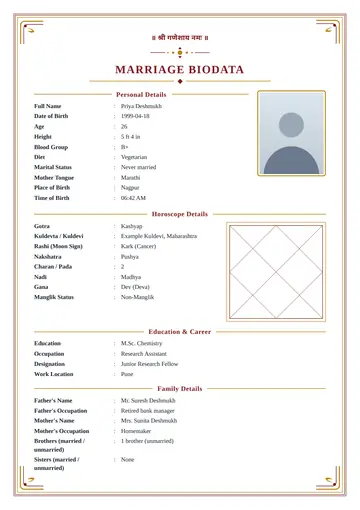
Many Hindu biodatas open with a blessing such as "Shri Ganeshaya Namah" or "Om". Horoscope details are common: gotra, rashi, nakshatra, manglik status, birth time and place, and sometimes a kundli (birth chart) image attached on the second page. Caste and sub-caste are listed by some families and left out by others.
Muslim
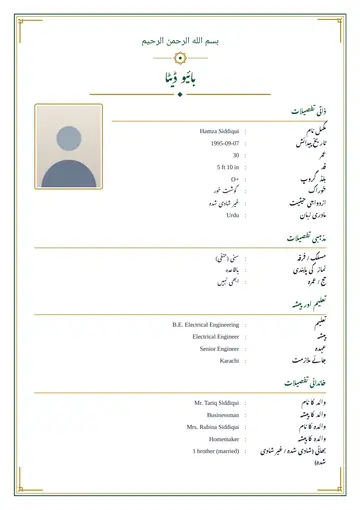
A Bismillah line at the top ("Bismillah ir-Rahman ir-Rahim", or the Arabic) is customary for many families and entirely optional. Headings are sometimes in Urdu or bilingual. Useful fields include sect or maslak (for example Sunni or Shia, if the family wants it listed), and a short note on religious practice. Horoscope fields are normally dropped. Right-to-left headings need a tool that lays out Urdu properly, or the letters can look disconnected.
Sikh
Some biodatas start with "Ik Onkar" or a similar line. Families often note whether the person keeps their hair and wears a turban or is clean-shaven, and which community or gotra they belong to, but only if it is relevant to them. Punjabi headings in Gurmukhi are common for biodatas that circulate in Punjab.
Christian
Typical extras are the denomination (Catholic, Protestant, Orthodox, Mar Thoma and so on), the parish or church, and sometimes a short Bible verse at the top. Horoscope fields are normally dropped. Family details often include the parents' church membership.
Jain
Useful fields include the sect (such as Digambar or Shwetambar), gotra or sub-community, and dietary practice, since many Jain families follow a strict vegetarian diet. Some families also mention religious observance such as regular temple visits.
Neutral or modern
If your family does not follow community conventions, use a neutral layout: name, photo, personal details, education and career, family, interests and contact. A short "about me" in two or three lines can replace the horoscope block.
PDF or image for WhatsApp?
Send a PDF when the receiver may print it, forward it to elders, or keep it in a folder. PDFs keep the layout fixed and the text stays sharp. Send an image (JPG or PNG) when you want people to read it straight inside the chat without opening another app; WhatsApp shows images in the conversation, while a PDF shows only a thumbnail of the first page.
A practical approach is to keep both: a PDF for formal exchange and an image of the first page for quick sharing. If you use an image, export at a good resolution so the small text is still readable after WhatsApp compresses it.
Privacy: what to leave out
- Full home address. The city and area are enough to start. Share the street address only after the families have spoken.
- Identity numbers. Never include Aadhaar, passport, bank or similar numbers.
- Personal phone and social media if the biodata will be shared widely. A parent's number is safer.
- Exact salary and property unless you are comfortable with strangers reading them.
- Photos of other people such as siblings, without their consent.
Remember that a document sent in a WhatsApp group can be forwarded further than you intended. Decide where it should go before you send it.
One page or two?
One page is the best default. It prints cleanly, reads well on a phone and forces you to keep only what matters. Use a second page only when it adds something specific, such as a kundli image, extra photos or a longer family section. If your content spills over by only a few lines, shrink the spacing or trim a field rather than leaving two lonely lines on page two.
Common mistakes
- Too many fields filled with "N/A". Remove empty fields instead.
- Different dates or spellings in different places (for example "Mumbai" and "Bombay").
- A blurry or heavily filtered photo.
- Long lists of conditions under expectations.
- Tiny text to squeeze everything on one page. If a reader has to zoom, shorten the content.
- Forgetting to update the age or job after a year.
Making it in Sezarr Resume
Sezarr Resume is an Android app that makes resumes, CVs, cover letters and marriage biodata. For biodata it has eight templates (Hindu, Muslim and Modern are free; Sikh, Christian, Jain, Buddhist and Royal come with Pro), fields for Hindu, Muslim, Sikh, Christian, Jain, Buddhist and neutral families that are all optional and renamable, headings in English, Hindi, Urdu, Bengali, Marathi, Tamil, Telugu, Gujarati and Punjabi, and a photo and a kundli image. You can export a PDF or a JPG or PNG image for WhatsApp, with no watermark and no sign-up. It is in closed testing on Google Play and coming soon; see the Sezarr Resume page for its status. It is a document maker only, not a matchmaking service. If you are writing a resume too, see the fresher resume format and the ATS friendly resume guides.
Questions people ask
What should be in a marriage biodata?
A name and photo, personal details, optional horoscope details, education and career, family details, a short expectations section and a parent or guardian contact. Keep it to one page where you can.
Is a horoscope section required?
No. Many Hindu families include gotra, rashi, nakshatra and manglik status, but it is optional, and families from other communities usually leave it out.
Should I send a biodata as a PDF or an image on WhatsApp?
A PDF keeps the layout and prints well. An image is easier to read straight in the chat. Many people keep both.
Should I include my full address?
It is safer not to. Give the city and area, and share the street address later, once the families have spoken.
Does a biodata need a photo?
Not necessarily. Most do have one, a clear head-and-shoulders photo, but you can leave it out of a widely shared document and send it privately.
Is Sezarr Resume a matrimonial site?
No. It only makes the biodata document on your phone. It does not match, list or contact anyone.